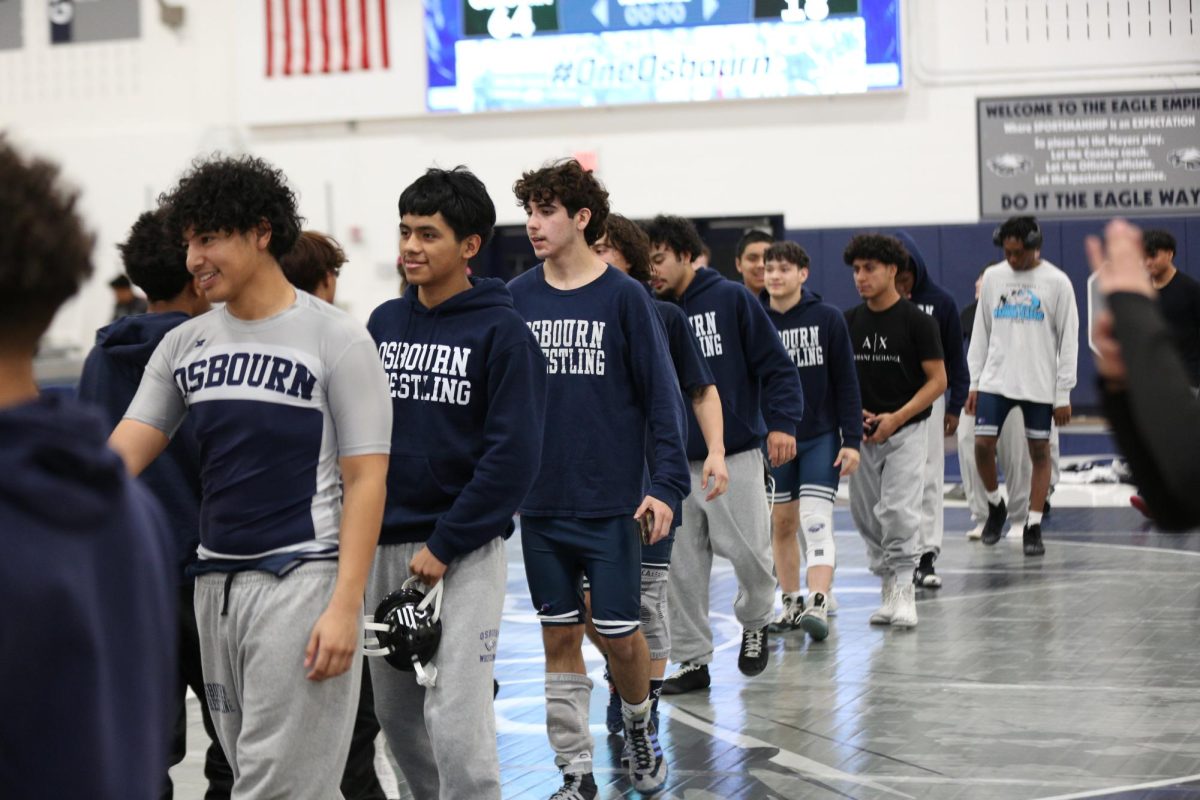
Every sport at Obsourn holds its own practice, and all of them have their differences. Zebdi Quintanilla, a freshman on the wrestling team, said, “A typical practice for us is jogging to warm up, learning drills, like takedowns, and going out in the hallway for conditioning. Then the coach gathers us and gives us important news, and then we weigh ourselves after we’re done.”
Like every sport, there is always something that you enjoy the MOST about your sport. It could be the stuff you physically do at practice, or even building connections with teammates could be your favorite part about what you do. Zebdi said, “My favorite part about wrestling is the people and learning new drills.” Of course, this may not be everyone’s favorite part of their sport, so if you have a different answer, let me know!
There is always a reason why you want to join sports. It could be because you’re already interested, or maybe you’ve heard great things about it. Sometimes, there isn’t a sport available, and you find interest in a similar sport. “When I was little, I wasn’t really good at any sports, and I wanted to join boxing. But I realized that schools didn’t have boxing as a sport, but I saw that they offered wrestling. So, I went to wrestling because it’s a combat sport and those are the only sports that I’m good at,” said Mateo Ordonez, a freshman on varsity.
But other times, you already know what you want to do. Zebdi already knew she wanted to join so, let’s hear about her dedication since day 1. “Honestly, I knew I wanted to do something with strength and technique and people I could be close with, and wrestling was just that. I was also watching wrestling matches, so that inspired me to join as well,” said Zebdi. Mateo also told me about how he practices at home. “When I’m at home, I either go on runs or I do calisthenics. I also work with weights I have.”
Now, I interviewed Robert Gray, the Varsity Assistant Coach of the wrestling team, and asked him about a few things some people might be curious about. For example, how do you think injuries get handled in wrestling? Coach Robert Gray said, “The first obstacle is identifying an injury vs a hurt. Hurting is a part of life. Wake up with a sore back from sleeping wrong or muscle soreness from working out; these are hurts, and we all have to live with them. For injuries, preventive measures are all we can do. We can prepare athletes for competition and practice, and that doesn’t mean there won’t be injuries. After injuries, when an athlete can return, we have a race against time to get an athlete in conditioning shape while trying to perfect their skill set.”
It is very common for athletes to get injured, so seeing how it gets handled by coaches is cool. Coach Robert Gray also told me about how he has been helping prepare his team. “We have a large wrestling team with 65+ athletes. Preparing this team has been one of the hardest things we have to do. We have athletes who are first-year wrestlers just learning technique, practicing beside a senior who’s looking for a state championship. The key is separating practices into three categories: helps new wrestlers, helps old wrestlers, and helps everybody. We start every practice with items that help everybody, then fit in the rest when we can. We show a large amount of technique in a small amount of time and hope that some of it sticks and perfects the rest when we have time. We use drills to bridge the gap between conditioning and skill training.”
Lastly, I know a lot of athletes, including me, manage to get into their own heads and doubt themselves. This is what Coach Gray said about when his athletes get in their own heads, “This is a hard question to answer. As an athlete myself, I dealt with this from year one till I retired from wrestling 25 years later. Here is what works for me and what I have them do. 1.) Acknowledge wrestling is a scary sport and love it anyway.) Rankings don’t matter if there was a 100% chance that the person was better, we wouldn’t have competitions. 3.) Focus on your match plan. The person you shake hands with is just an obstacle, not a person. 4.) Work as much as possible. Build the confidence that you know you outworked your opponent.”
I am so grateful for the people that I was able to interview because we got a little peek into what goes on in wrestling, and especially thank you to Coach Gray for letting us know how he helps handle situations and how he has been helping to prepare the wrestling team.